Software overview
HemiSpec is organized as a package-first software ecosystem rather than a collection of standalone scripts. Current documentation targets a source installation from main; archived versions remain on the GitHub Releases page, and the PyPI project is not public. The Python package is the primary artifact; the CLI and GUI entry points are built from the same public API.
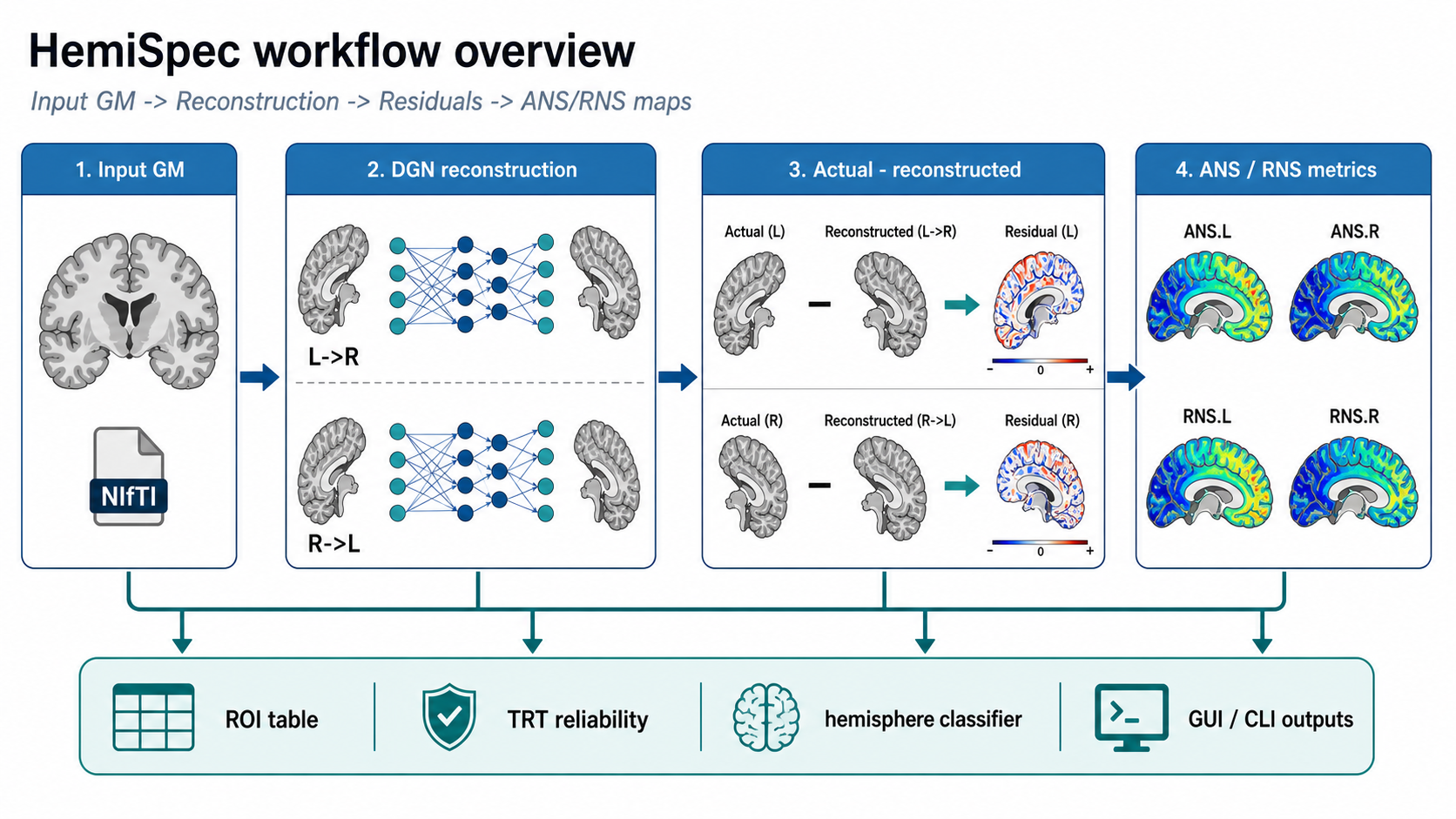
User-facing layers
| Layer | Public name | Status | Purpose |
|---|---|---|---|
| Python package | hemispec-toolkit |
Primary public artifact | Installable API plus CLI/GUI entry points in the active Python/PyTorch environment. |
| CLI | hemispec |
Package entry point | Scriptable workflows for servers and clusters. |
| GUI | hemispec-gui |
Package entry point | Desktop launcher for ANS/RNS generation, optional ROI tables, and optional validation, run from the same environment as PyTorch. |
| Compiled app | HemiSpec Desktop / HemiSpec Model App | Build target | Optional folder distributions built from a source checkout. |
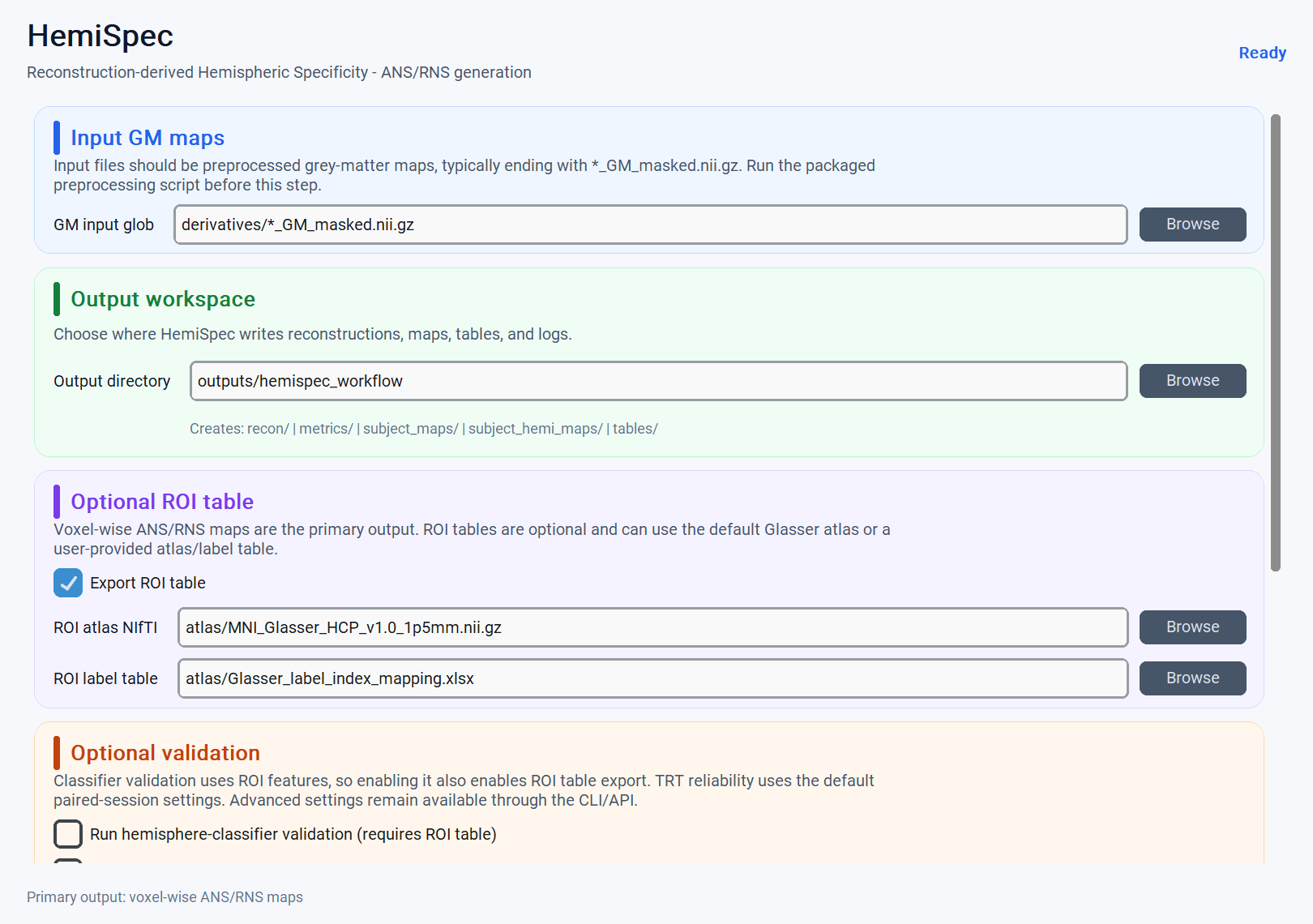
Current GUI scope
The default GUI is intentionally narrow. It exposes the decisions normal users need to obtain ANS/RNS maps:
- preprocessed GM input glob,
- output workspace,
- optional ROI table export with atlas and label table paths,
- optional hemisphere-classifier validation,
- optional TRT reliability,
- run/open/copy-CLI/log controls.
It does not expose model checkpoints, device selection, thresholds, suffix rules, classifier bundle paths, or TRT regexes. Those advanced settings remain available through the CLI/API so that the GUI remains reproducible and easy to maintain.
Current release split
- Current source package: CLI, compact GUI launcher, compute, ROI export, validation, and inspection without bundling subject data or unapproved atlas assets.
- Model-enabled environment: end-to-end DGN inference plus ANS/RNS workflows using DGN and classifier assets from a Git LFS checkout or explicit approved local assets. Current
maincan cache-download DGN checkpoints from Git LFS media, but not the complete classifier bundle; see Data and models.
Atlas files remain optional for ROI export. The released classifier, however, requires its compatible Glasser 1.5 mm atlas and labels 1..180 left / 1001..1180 right; custom atlases are ROI-only. Public builds should not silently bundle private assets.
ANS/RNS and the cross-hemispheric DGN framework originate from Wang et al. (2024); see Citation.